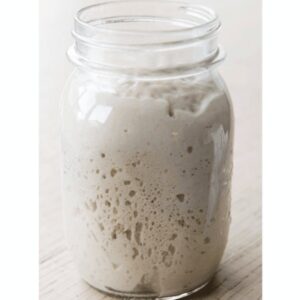
In short: a sourdough starter (in Italian, lievito madre) is a dough of flour and water in which natural yeasts and lactic acid bacteria ferment on their own. You make it at home from strong flour and water, “feed” it with regular refreshments, and it’s ready when, dropped into water, it floats to the surface within 20–25 minutes and doubles in volume in 4 hours. It’s slower than fresh yeast, but it gives aroma, softness and a longer shelf life – for panettone, it’s essential.
To me, a sourdough starter is like a living thing: it needs feeding, looking after and listening to every single day. Every year I get the same questions, so I’ve gathered them here and I’ll answer them one by one.
Fresh (baker’s) yeast is a single microorganism, selected and always the same. A sourdough starter, on the other hand, is a small community of yeasts and lactic acid bacteria that arise naturally from flour and water. That’s why it works more slowly, but it gives you aroma, a delicate acidity and doughs that stay soft for longer.
All you need is flour, water and patience.
The difference is the water. A stiff starter has little water (in my refreshments, 40% of the flour weight); a liquid starter (the so-called Li.Co.Li.) has equal parts water and flour. A stiff starter gives structure and a soft, fragrant crumb, and it’s the one I use for large leavened bakes such as panettone and colomba. A liquid starter is easier to manage and is widely used for bread.
If you use it often, once a day at room temperature. If you keep it in the fridge, at least once a week. Before a big bake such as panettone, though, you need several refreshments close together to bring it to full strength.
Look at three things:
The bath is a soak in water before the refreshment: I do it for 10 minutes in water at 32 °C with 1.5 g of sugar per litre. It removes some of the acidity on the surface and makes the starter sweeter. I keep my own starter in water, because for sweet leavened bakes I want a starter that’s strong but not sour.
There’s no exact conversion, because the timings change too. As a starting point, for bread you usually use 200–250 g of refreshed starter per kilo of flour, and the rising times get several hours longer. For sweet leavened bakes you’ll find the amounts in the recipe, because yeast, sugars and fats have to be balanced together.
In the fridge it keeps well for a week between refreshments: a stiff starter wrapped tightly in a cloth tied with string, a liquid one in a closed jar. If you’re going away for a long time you can freeze it straight after a refreshment; when you take it out again, it needs a few days of refreshments to get back into shape.
The cause is almost always the temperature or how often it’s refreshed. Keep it between 26 and 28 °C, refresh it more often and, if it’s very sour, give it a bath before the refreshment. A sourdough starter can almost always be saved: it just takes consistency.
Yes, starting from gluten-free flours such as rice flour. In the gluten-free colomba course I use compressed yeast, but I also explain how to adapt the recipe if you have your own gluten-free starter.
Chef’s tip: always write down the time, the temperature and how long each refreshment takes to double. Within a few days you’ll understand how your starter “thinks” – and that’s what makes the difference between a good panettone and an extraordinary one.
Want to learn it with me, step by step?
In my video courses I show you every step, with the quantities and handouts to download.
 Video courseStiff sourdough starter and its mysteriesWatch the course →
 Video courseImpariamo tutto sul lievito madre a coltura liquidaWatch the course →
Luca Montersino
Chef and pastry chef, the face of the Italian TV shows Peccati di Gola and È sempre mezzogiorno, author of more than 24 books and a pioneer of healthy patisserie. About me

Luca Montersino S.r.l.
C.O.E. SM28619
Registered in the San Marino E-commerce Register under no. 803 for online services
Registered in the San Marino E-commerce Register under no. 810 since 23/11/2020 for B2C sales
Registered and operating office:
Strada Genghe di Atto, 136
47892 Acquaviva
Republic of San Marino
©2023 Luca Montersino Srl - Credits Underscore Srl
A year of courses for
199€
instead of 249 €
Every lesson in the online Academy, plus the new Christmas courses: panettone, pandoro and sfogliatella.
Get the Black Friday dealOnly until 30 November
Price valid for the first year, then €249 a year. You can turn off auto-renewal whenever you like. Click and the discount is applied automatically.
Our pastry products are fresh and handmade, so we can only deliver them within Italy and San Marino.
Wherever you are in the world, though, you can learn to make them yourself with Luca’s video courses.
Browse the video coursesShipping to Italy or San Marino? See this product in Italian
