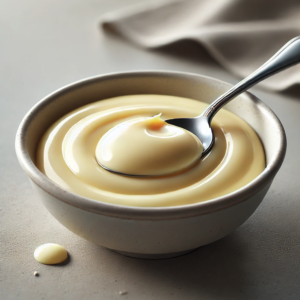
In short: Montersino’s pastry cream is made with the whipped method. The egg yolks, whipped with the sugar until pale and foamy, are poured onto the boiling milk and cream: they float and cook without stirring, so the cream doesn’t catch on the bottom. For about 900 g of cream you need 400 g of whole milk, 200 g of fresh cream, 150 g of sugar, 150 g of egg yolks, 20 g of cornflour, 20 g of rice starch and a vanilla pod. As soon as it’s cooked, smooth it with a stick blender – only while it’s hot – then cover it with cling film pressed onto the surface.
Today I’m going to show you how to make my pastry cream with the whipped method. It’s an interesting method, especially for large batches, because you don’t have to keep stirring the cream: you make it without stirring at all.
That way you get an excellent pastry cream with no risk of it catching on the bottom of the pan – and you save yourself all that stirring.
The video is in Italian.
First of all, I put the milk and cream in a pan.
I use milk plus some cream because the cream makes the pastry cream creamier: it contains more fat than milk.
Cream also helps the pastry cream keep for longer. The richer a pastry cream is in fat and sugar – so the more yolk and cream it has – the longer it keeps.
You can also finish it with butter, but then you’d have to add more sugar, because the yolk needs to be protected by sugar, which stops the yolk proteins from coagulating.
So a pastry cream that’s rich in yolk needs plenty of sugar; and lots of yolk, lots of sugar, cream and fat give you a pastry cream that keeps longer in the fridge.
Stainless steel pans tend to catch badly, especially on an induction hob.
Put a steel pan on an induction hob and the milk and its proteins will stick to the bottom.
So I add some of the sugar from the recipe by eye – about 100 g – straight into the milk, where it sinks to the bottom of the pan.
This stops the milk proteins coagulating and sticking to the pan, so you won’t get that unpleasant layer of burnt-on milk on the bottom.
The rest of the sugar goes in with the yolks for whipping.
I take some excellent Bourbon vanilla pods and split them lengthways.
Of course it’s an expensive amount – a luxury, certainly – but worth it, because a vanilla pastry cream should taste of vanilla: one pod per litre of milk.
Below that, anything goes, even one pod per two litres of milk – but if you want a really first-class pastry cream, you need one pod per litre.
If the vanilla is good quality, you’ll get plenty of seeds out of it.
You can recognise good vanilla because the pod is soft: you can wrap it around your finger without it snapping, and you can feel that it’s full of seeds.
Split the second pod too and scrape out the seeds well. Don’t throw the pods away: dry them and blitz them with sugar.
Ten spent pods, with the seeds removed, blitzed thoroughly in a blender with a kilo of sugar give you a kilo of vanilla sugar.
It’s very good in pastry cream: next time, instead of using vanilla pods, you can add some of the vanilla sugar made this way.
Stir the vanilla seeds well into the hot milk and cream, together with the small amount of sugar I mentioned earlier.
Now I whip the yolks with the sugar and the starch.
I put the egg yolks and the rest of the caster sugar in the stand mixer.
Remember the two kinds of starch: rice starch and cornflour.
Now I whip the eggs so that they take in air.
Rice starch gives the pastry cream its creaminess, but it doesn’t have much holding power: the cream tends to be a little soft.
That matters for cakes that need structure, so the cream doesn’t ooze out – especially Italian-style cakes assembled without a ring, where the cream has to hold its shape.
Cornflour gives structure – a “set”, custard-pudding texture – but on its own the cream ends up too firm, too much like a pudding.
So combining cornflour and rice starch gives my pastry cream just the right creaminess and just the right body.
I whip until the eggs are nice and pale and have taken in enough air to float on the surface of the milk – that’s what lets you make the cream without stirring.
I take the whipped eggs off the mixer and go back to the pan, where the milk is about to boil.
If I touch the bottom with the whisk, I can’t feel anything sticking at all – thanks to the sugar. Remember: it may seem strange, but milk really does catch on the bottom of the pan.
I’ll say it again: especially with a steel pan on an induction hob.
When the milk comes to the boil – give it another minute until you see the first bubbles rising, there they are, perfect – I turn down the heat (in this case the induction) and pour the eggs on top. They float: look, you can see them floating on the surface of the milk.
They don’t sink, because we’ve whipped air into them. So now I don’t need to worry about the cream catching, because there’s only milk on the bottom of the pan – and, as we said, here the milk won’t stick – while the eggs float on top.
So, first, they’re not sticking to the pan and, second, they’re starting to heat up.
The milk bubbles up through them like a volcano – someone has nicknamed it my “volcano cream”.
I don’t stir the pastry cream, because the sugar protects the yolk from coagulating, so you won’t get that scrambled-egg effect.
The eggs are heating up and the cream isn’t catching: on its own, without stirring, the milk keeps bubbling up through the eggs, and as it passes through them it cooks them.
When I see that the boiling has gone right through the eggs, I can put the whisk in and start mixing. In fact the cream is already cooked, it just isn’t mixed enough yet.
At this point I turn off the heat and whisk only to combine the cream – it’s already cooked, just not mixed enough.
The cream will drop in volume.
I mix it just enough to bring it together.
Now we take the stick blender, because the cream has taken in air this way, and air and pastry cream don’t get on very well.
Air gives the pastry cream a texture that isn’t smooth, so we blend it with the stick blender to smooth it and knock the air out.
You can blend pastry cream only, and I mean only, when it’s just made and piping hot. If you blend it cold from the fridge, you break the gel and the cream turns liquid.
If I blend it now, on the other hand, it becomes perfectly smooth and a little runnier.
You’ll see in a moment that it gets a little runnier, because blending loosens it slightly – but as it rests in the fridge the starch will set it again, with the right body for piping.
So remember: blending is fine only when the cream has just been made.
Keep going until it’s nice and glossy; it will also be much softer than it was at the start.
OK, we can stop here: the cream is lovely, fluid and smooth. As you can see it’s loose, but don’t worry – as it cools it will set again.
Alternatively, you can finish it with 50 g of butter per litre of milk: add a knob of butter to give it extra creaminess, more body and a longer shelf life.
Of course, at this stage the cream is hot and the butter will melt.
I’ll say it again: don’t blend the cream when it’s cold, because if you do it turns liquid and never comes back.
Blended hot, though, tomorrow morning when I take it out of the blast chiller – I’m chilling it now – it will be as thick as a pastry cream should be.
If I blended it tomorrow morning, once cold, it would turn liquid and never set again.
So remember: blend it piping hot, straight after making it, and the starches then have the whole night to set further and form the gel that gives our pastry cream its structure.
This is a basic vanilla pastry cream; you can then make it hazelnut, chocolate or pistachio simply by adding flavourings to it.
Pour it into a wide, shallow container.
Always press cling film onto the surface – a lid isn’t enough, or a skin will form, and tomorrow when I use the cream it will have turned into lumps.
So prevent the skin by putting the cling film directly on the surface first, then the lid.
Press it on well. Then put the lid on and blast-chill it (positive chilling).
If tomorrow, or once it’s cold, I want to turn my cream into chocolate, hazelnut or pistachio cream, I add as much pistachio paste as I like and stir it in with a hand whisk – not a stick blender, or it will just go runny.
And now I’m going to blast-chill our pastry cream. See you at the next recipe or the next technique on my blog – and don’t miss the other tips and recipes!
Chef’s tip: don’t throw away the vanilla pods after scraping out the seeds. Dry them and blitz 10 of them with 1 kg of sugar: you’ll get a kilo of vanilla sugar to use next time instead of a pod.
Rice starch gives creaminess but little structure; cornflour gives body but makes the cream a little “puddingy”. Together they give the right creaminess and enough hold even for cakes assembled without a ring.
Cream contains more fat than milk: it makes the pastry cream creamier and helps it keep longer in the fridge.
Yes: 50 g of butter per litre of milk, added while the cream is still hot, gives more creaminess, more body and a longer shelf life.
For a top-quality pastry cream, one pod per litre of milk. A good pod is soft, wraps around your finger without snapping and is full of seeds.
Start from this vanilla pastry cream: once it’s cold, add pistachio paste, hazelnut paste or chocolate in whatever amount you like, stirring with a hand whisk.
Want to learn it with me, step by step?
In my video courses I show you every step, with the quantities and handouts to download.
Every course with one subscriptionLuca Montersino
Chef and pastry chef, the face of the Italian TV shows Peccati di Gola and È sempre mezzogiorno, author of more than 24 books and a pioneer of healthy patisserie. About me

Luca Montersino S.r.l.
C.O.E. SM28619
Registered in the San Marino E-commerce Register under no. 803 for online services
Registered in the San Marino E-commerce Register under no. 810 since 23/11/2020 for B2C sales
Registered and operating office:
Strada Genghe di Atto, 136
47892 Acquaviva
Republic of San Marino
©2023 Luca Montersino Srl - Credits Underscore Srl
A year of courses for
199€
instead of 249 €
Every lesson in the online Academy, plus the new Christmas courses: panettone, pandoro and sfogliatella.
Get the Black Friday dealOnly until 30 November
Price valid for the first year, then €249 a year. You can turn off auto-renewal whenever you like. Click and the discount is applied automatically.
Our pastry products are fresh and handmade, so we can only deliver them within Italy and San Marino.
Wherever you are in the world, though, you can learn to make them yourself with Luca’s video courses.
Browse the video coursesShipping to Italy or San Marino? See this product in Italian